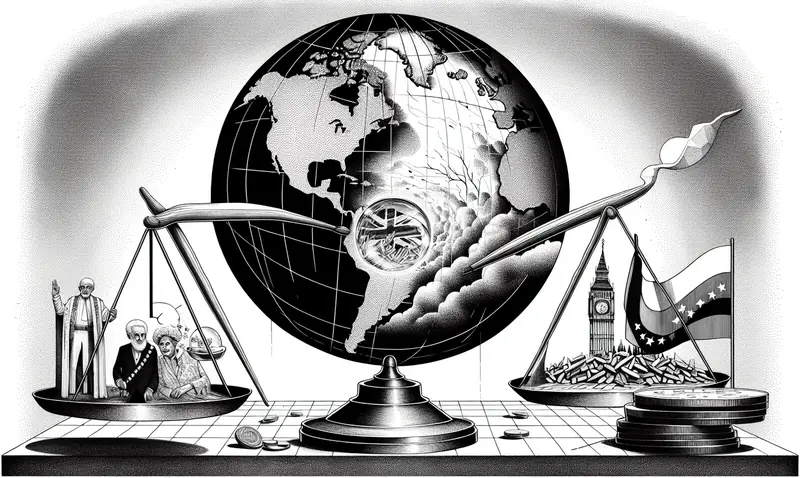
As we step into 2026, the world feels like it's teetering on the edge of a new geopolitical landscape, with the US military recently launching an attack on Venezuela, capturing its president, Nicolás Maduro, and stirring up a storm of confusion and concern. The UK, for one, seems to be scratching its head, unsure of what this means for international relations and whether it smacks of colonialism. The chief secretary to the prime minister, Darren Jones, emphasized a desire for a peaceful transition in Venezuela, which sounds rather optimistic when faced with the chaos of US intervention [1].
It's almost comical, in a dark way, to think that while the US is flexing its military muscles in South America, right-wing commentators are already eyeing Greenland with dreams of annexation. Just hours after the Venezuelan bombardment, a map of Greenland draped in stars and stripes made the rounds on social media, igniting outrage from the Danes who were quick to remind everyone that they remain close allies with the US and expect full respect for their territorial integrity [2]. A reminder, perhaps, that the political landscape can pivot from the serious to the absurd in seconds.
Meanwhile, as global tensions rise, the tech world is grappling with its own crises. A tragic lawsuit has emerged in the wake of a deadly accident involving a Tesla, where a family blames the car's Autosteer feature for veering into the path of an oncoming truck, resulting in the deaths of four relatives [3]. It’s a stark reminder of how technology, once heralded as a solution to our problems, can also lead to devastating consequences. Perhaps it’s fitting that, in this chaotic world, we’re also seeing the launch of Subtle’s new noise-canceling earbuds, designed to help users speak clearly in loud environments. These earbuds could be seen as a metaphorical lifeline for a society drowning in noise—both literal and figurative [4].
On a more hopeful note, a recent clinical trial suggests that mindfulness and slow breathing practices may slow brain aging and reduce the risk of Alzheimer's disease[5]. It’s a gentle nudge toward introspection amidst the chaos of politics and technology—a reminder that perhaps we should take a moment to breathe deeply and reflect on the world around us. Speaking of reflection, schools in Nigeria are set to reopen after a mass abduction in November, a move that feels both hopeful and precarious given the ongoing security issues in the region [6].
As we dive into this new year, the tension between our technological advancements and the realities of our geopolitical landscape seems more pronounced than ever. With every click, tweet, and news alert, we’re reminded that while we may be advancing in some ways, the path ahead is fraught with challenges, both old and new.